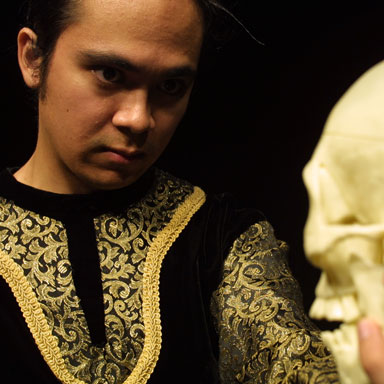
 Madness
in great ones
Madness
in great onesmust not unwatch'd go ...
Madness
in great ones
must not unwatch'd go ...
Hamlet
by William Shakespeare
directed by R. Kevin Doyle
July 19 - August 8, 2003
Madness, murder and mayhem
follow the melancholy Prince
of Denmark as he seeks to avenge
his father's death.
Cast
| Reb Beau Allen | Player Queen, Francisco Gravedigger, Ghost |
|
| Robb Bonnell | Hamlet | |
| Scot Davis | Laertes | |
| D.G.K. Fujitani | Player King Fortinbras |
|
| M.J. Gonzalvo | Osric, Reynaldo, Captain Cornelius, Gentleman #2 |
|
| Taurie "Godess" Kinoshita | Ophelia | |
| Blake Kushi | Polonius, Priest | |
| Alissa Joy Lee | Voltemand, Gentlewoman | |
| Ben Lukey | Rozancrantz | |
| Mike Mariani | Barnardo, Player #3 Gravedigger's Companion |
|
| Jeremy Pippin | Horatio | |
| Chris Reil | Guildenstern | |
| Shen Sugai | Claudius | |
| Danel Verdugo | Gertrude | |
| Henry West | Marcellus |
Director’s note
In Shakespeare's life, and shortly after his death, there
were three published versions of The Tragedie of Hamlet, Prince of Denmarke.
Two were stand alone volumes called quartos, and one was with a collection of
all of Shakespeare's plays called the First Folio.
One of the two quartos was considered to be fairly inaccurate; sort of
like a novel about a movie rushed into printing to capitalize on the movie's
success. The second quarto is considered to be accurate to what Shakespeare
wrote, as is the version published in the First Folio.
Of course, the problem is that the second quarto and the first folio are
different in several regards. Also, there are a couple of passages in the first
quarto that, for whatever reason, are considered more accurate than either of
the other editions.
This means that scholars, in attempting to construct a definitive edition
of Hamlet need to look at all three versions to create a copy of
Hamlet that you would pick up in a book store. One popular publisher of
Shakespeare, Arden, has even given up trying to create a definitive edition and
will just publish all three versions of Hamlet later this year.
In addition, Shakespeare (or his publishers) didn't always use accurate
spelling when they made their books. For example, there is a famous speech of
Hamlet's that begins "Oh, that this too, too sullied flesh..." or maybe "too,
too sallied flesh..." or, perhaps, "too, too solid flesh." Thus, between the
different editions and the variant spellings, scholars can't quite agree on
whether there is a definitive version of Hamlet or not.
Over the years, scholars and directors have made a number of assumptions
about the play that have come to be thought of as fact that are, in fact, bunk.
The Arden Shakespeare folks do a pretty good job of debunking many of these
Shakespearean urban myths.
For example, everyone knows that when Hamlet tells Ophelia to "get thee
to a nunnery," that he is really referring to a whorehouse. Well, the folks at
Arden did some research and found that, in Shakespeare's time, when people said
"nunnery," they meant a place where nuns live. It wasn't until a hundred years
later that scholars decided it meant the other.
Ultimately, a modern director staging Hamlet needs to wade through all of
this material and figure out how to best make the play entertain a modern
audience. I believe that the best way to do this is to follow Dr. James
Brandon's method of translating Kabuki theatre for an American audience: use the
model and make it work. My understanding of this is that a director should try
to identify how the play worked for it's original audience and then try to make
it work for the new audience in a similar way. For this production, I used the
Arden as my guide in determining how the play worked for an audience in
Shakespeare's time. Ultimately, I hope that our production works for you.
Thank you for coming and enjoy the show.